
Environmental Consultancy

Expert Environmental Impact Assessment and clearance services, ensuring your projects comply with India’s environmental regulations while promoting responsible growth.
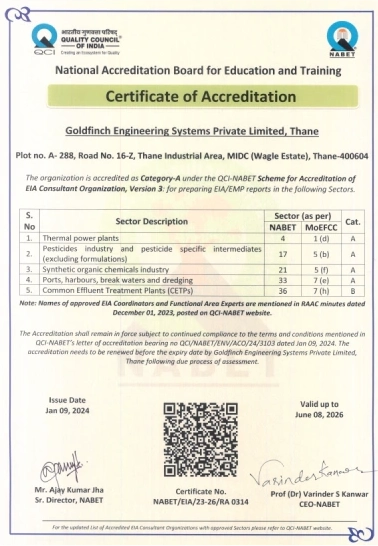
NABET

NABET Accredited
Category-A Consultant

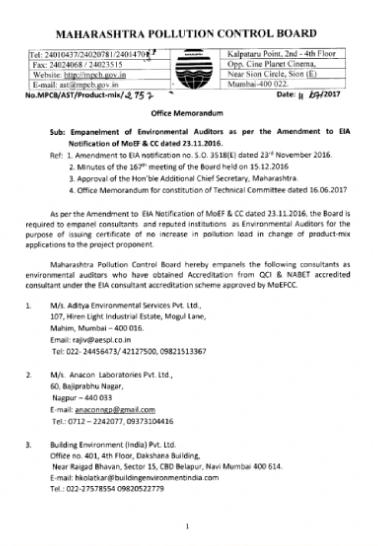
pollution control board

MoEF&CC Gazetted Recognition

Nationally Recognized

NABET Accredited Sectors

Goldfinch is officially accredited by the Quality Council of India – National Accreditation Board for Education and Training (QCI-NABET) as a Category-A EIA Consultant. This allows us to prepare EIA-EMP studies and obtain clearances for major development activities in key industrial sectors. Our accredited sectors include:
Pesticide Industry

Pesticides Industry  

Organic Chemical Industry

Synthetic Organic Chemicals Industry
Ports Harbours

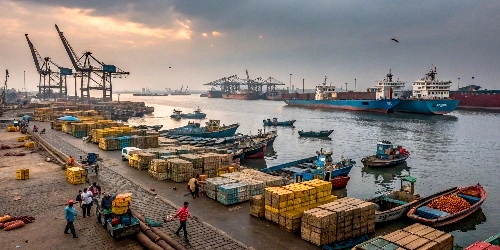
Ports, Harbours, Breakwaters & Dredging
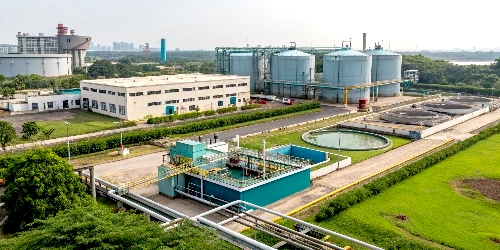
Effluent Treatment Plants

Common Effluent Treatment Plants (CETPs)

logo

Accredited Capability

These accreditations mean our organization meets strict national standards for technical competence and quality control. We have approved EIA Coordinators for each functional area relevant to these sectors, ensuring we understand industry-specific regulations and can efficiently manage EIA studies and clearance processes tailored to your sector.

EC Procedure

Environmental Clearance Process

Securing an Environmental Clearance (EC) involves a structured multi-step procedure. Goldfinch guides clients through each stage to ensure timely compliance and approval.

Screening & Categorization

Step 1

We determine the project’s category (A or B) under the EIA Notification. Category A projects require clearance from the central MoEF&CC, whereas Category B projects are appraised by the State Environmental Impact Assessment Authority (SEIAA).

Scoping & ToR Preparation

Step 2

We prepare a detailed Terms of Reference (ToR) outlining the scope of the EIA study (air, water, noise, ecology, etc.) and submit it to the appropriate authority for approval.

Baseline Studies & Impact Analysis

Step 3

Our team conducts comprehensive environmental surveys (baseline air/water/soil quality, biodiversity assessments) and uses this data to predict potential impacts, including risk analyses for accidents in high-hazard industries.

Draft EIA Report & Public Consultation

Step 4

We compile a draft EIA report detailing impacts and proposed mitigations, then facilitate the statutory Public Hearing. Local stakeholders and community members are consulted, and their feedback is recorded and addressed.

Final EIA/EMP Submission

Step 5

After public input, we finalize the EIA report and Environmental Management Plan (EMP), and submit these along with any required NOCs (e.g., from State Pollution Control Boards) to the authorities.

Appraisal & Decision

Step 6

The EIA report is reviewed by the Expert Appraisal Committee (for Category A) or State EAC (for Category B). If all regulatory criteria and mitigation measures are met, Environmental Clearance is granted.
logo

Approval Workflow

This systematic approach – from initial screening to final clearance – is designed to ensure that all environmental regulations are satisfied and that projects proceed without delays or violations.
Environmental Specialists

Multi-Disciplinary Excellence

Our strength lies in a versatile, multi-disciplinary team of specialists with deep experience in environmental regulations and technical assessments. We employ: chemical and environmental engineers for process and pollution control expertise; air quality and water resources experts for dispersion modeling and hydrology; ecology and biodiversity biologists for habitat surveys; risk and safety analysts for hazard studies; and socio-economic consultants for community impact and resettlement planning.

Each sector has unique environmental challenges, and our consultants have worked across industries like chemicals, pesticides, infrastructure, ports, and more. This broad expertise enables us to tailor every EIA study, environmental audit, or compliance program to the project’s specific needs. Combined with our extensive practice before MoEF&CC/SEAC and state authorities, our team delivers authoritative guidance throughout the lifecycle of your project.
Chemical & Environmental Engineers
Air & Water Resources Specialists
Ecology & Biodiversity Biologists
Risk & Safety Analysts
Socio-Economic Consultants
Industry Specialists
logo

Sector Specialists

Sector-Specific Expertise: Each industry presents unique environmental challenges. Our consultants have extensive experience across chemicals, pesticides, infrastructure, ports, and more. Combined with our practice before MoEF&CC/SEAC and state authorities, we deliver authoritative guidance throughout your project lifecycle.
Consultancy Services

Comprehensive Environmental Services

End-to-end consultancy services addressing every aspect of regulatory compliance and sustainability for industrial and infrastructure projects.
Environment Clearance (EC) Applications
Environmental Impact Assessment (EIA/EMP)
Coastal Regulation Zone (CRZ) Clearances
Consent to Establish/Operate (CTE/CTO)
ACTO Amendments (CIPM & NIPL)
Air Pollution Dispersion Modeling
Proven Expertise

Why Choose Goldfinch

Comprehensive support for navigating India’s environmental regulatory landscape with expert liaison services
Accredited and Certified
Multidisciplinary Expertise
Proven Track Record

End-to-End Service

Regulatory Relationships
Client-Centric Approach
logo

Trusted Guidance

Goldfinch combines authoritative technical knowledge with practical, hands-on experience to ensure your projects are both regulatory-compliant and environmentally responsible. Our integrated approach helps build trust with regulators and communities, enabling projects to proceed on time and on budget. By choosing Goldfinch, you partner with an environmental consultant dedicated to quality, integrity, and sustainable development
accredited
FAQ

Frequently Asked Question

combining technology, science, and community engagementMulti-sector collaboration driving the recovery effort
What is an Environmental Impact Assessment (EIA)?
EIA is a structured process to evaluate the potential environmental consequences of a proposed project before it is approved. It identifies, predicts, and assesses the impact on the environment and suggests mitigation measures. In India, it is governed mainly by the EIA Notification, 2006 under the Environment (Protection) Act, 1986.
Projects listed in Schedule of the EIA Notification, 2006—such as mining, thermal power plants, chemical industries, infrastructure, and ports—require EIA clearance. Depending on project size and category, they may need clearance from either the MoEF&CC (Category ‘A’ projects) or SEIAA/SEAC of the respective state (Category ‘B’ projects).
  • Category A: Larger or environmentally sensitive projects appraised by the Expert Appraisal Committee (EAC) at the central level (MoEF&CC).
  • Category B: Smaller projects appraised by the State Environment Impact Assessment Authority (SEIAA). Category B is further divided into B1 (requires full EIA) and B2 (no EIA, only EMP or Form-1).
  • Public Hearing by State Pollution Control Board (SPCB) in the project-affected area, with advance notice and accessible EIA documents. Written Responses from stakeholders sent to the regulatory authority.
  • The aim is to incorporate public concerns into the decision-making process.
The validity of an Environmental Clearance (EC) depends on project type:
  • Validity of Environmental Clearance for Synthetic Organic Industry, Pesticides, CETP and Ports and Harbours is 10 Year
  • Extension may be granted if applied before expiry.
  • Environment (Protection) Act, 1986
  • EIA Notification, 2006 (and subsequent amendments)
  • Relevant sector-specific laws (e.g., Water Act, Air Act, Forest Conservation Act, Wildlife Protection Act) when applicable.

No. Starting construction, production, or land development without prior EC is a violation. This can lead to:

  • Project stoppage orders
  • Penalties under the Environment (Protection) Act
  • Requirement to apply for ex-post facto clearance, which may still be rejected.
Life Cycle Assessment is a scientific method to evaluate the environmental impacts of a product, process, or service throughout its life cycle—from raw material extraction to disposal. It helps industries identify hotspots for improvement, comply with environmental standards, and demonstrate sustainability performance to regulators and customers.
  • Implement all mitigation measures mentioned in the EC letter.
  • Submit half-yearly compliance reports to MoEF&CC/SEIAA and upload them on the company website.
  • Maintain records of environmental monitoring (air, water, noise, soil).
  • Obtain consent from the Pollution Control Board (CTE & CTO).
  • Follow conditions related to greenbelt, waste management, and CSR.

Violations can lead to:

  • Show-cause or closure notices from MoEF&CC or SEIAA.
  • Revocation of clearance.
  • Monetary penalties under the Environment (Protection) Act, 1986.
  • Prosecution and possible imprisonment. Projects may also be ordered to undergo ex-post-facto clearance, which carries reputational and legal risks.
Dedicated Specialists

Meet Our Team

Experienced environmental professionals dedicated to ensuring accuracy, reliability, and full regulatory compliance in every technical assessment.
goldfinch-placeholder

Name

7-8 word description about what they do

goldfinch-placeholder

Name

7-8 word description about what they do
goldfinch-placeholder

Name

7-8 word description about what they do
goldfinch-placeholder

Name

7-8 word description about what they do
Sector Support

Industries We Serve

Collaborating across sectors to provide robust environmental regulatory support and accurate technical assessments

Synthetic Organic Chemical Industry

Pesticide Industry

Common Effluent Treatment Plants (CETPs)

Ports & Harbours

Proven Impact

Case Studies

Real-world success stories demonstrating our expertise 

High-Strength Effluent Biotreatment

Treated effluent met regulatory discharge limits for organics and pesticide residues; plant compliance restored and operating costs reduced via optimized aeration/nutrient control and lower chemical dosing

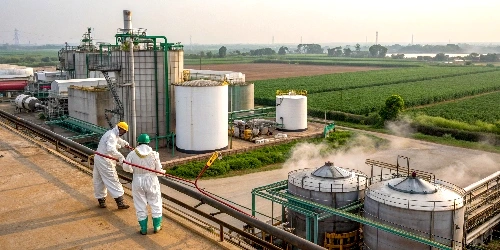
A major pesticide (agrochemical) manufacturing plant faced very high-strength wastewater with toxic organics and salts. Goldfinch’s team conducted a detailed treatability analysis in its MOEF-approved laboratory. we designed a 500 m³/d biological treatment system (bioreactor) to handle the plant’s effluent (TDS ≈70,000 ppm). Bench-scale trials varied pH, nutrients and microbial cultures to optimize degradation of pesticide residues. The pilot testing showed that the optimized biotreatment could remove the bulk of the organic load. After implementation, the upgraded ETP consistently met discharge standards, significantly reducing organic COD and pesticide concentration in the effluent. This approach improved compliance and lowered operating costs for the plant.

Environmental Management Plan (EMP) / Environmental Impact Assessment (EIA)

EIA/EMP provided actionable mitigation and monitoring; regulatory clearance secured and construction proceeded with minimized ecological disturbance and clear compliance pathways

Goldfinch prepared the Environmental Impact Assessment (EIA) for a coastal port expansion as a Category A accredited consultant. Comprehensive baseline studies covered water quality, sediment, marine ecology, and noise. Using these data, potential dredging impacts were modeled, and best-practice mitigation—controlled spoil disposal, silt curtains, and timing restrictions—was recommended. The MoEF–NABET-compliant EIA/EMP guided project design, secured regulatory clearance, and ensured environmentally responsible expansion with minimal ecological disturbance and full compliance.

Cluster ETP Optimization

CETP achieved steady compliance across key parameters, reduced sludge and energy consumption, and improved resilience to load fluctuations

An industrial cluster’s CETP was underperforming due to variable loads and shock contaminants. Goldfinch conducted bench-scale treatability tests to identify optimal coagulant dosing, aeration, and treatment schemes. The process was reconfigured with pH adjustment, step-feed aeration, and membrane polishing to improve COD/BOD removal. Pilot trials confirmed enhanced efficiency. The upgraded CETP met all discharge standards, reduced sludge and energy use, and achieved reliable, cost-effective compliance through Goldfinch’s laboratory-led optimization approach.